

A correctional TV system works when it matches the facility’s security rules, building layout, and staff workload, not when it simply has the most channels. Television gives people in custody news, recreation, and educational programming and gives administrators a way to manage what is shown and where. This guide covers why facilities provide TV, which distribution approaches exist, how correctional requirements differ from a hotel or hospital, what to put in a bid, and how installation works inside a secure site.
If you are comparing options now, jump to the planning checklist or the procurement section. For PulseTVNet’s wider commercial work, see our Hospitals & Institution page and the list of who we help.
Why Correctional Facilities Provide TV
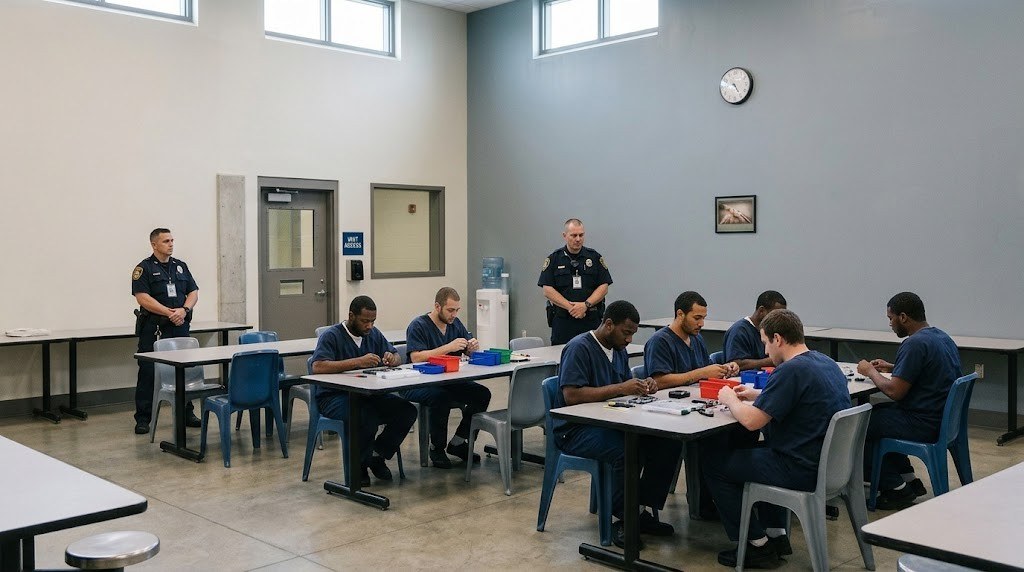
Facilities provide television for four practical reasons: access to outside information, structured recreation, behavior management, and educational content. Its value depends on the programming available and how access is managed, and TV alone does not guarantee fewer incidents.
Information and reduced isolation. News and shared viewing keep people in custody connected to current events. Queensland Corrective Services has discussed TV as part of reducing isolation in safer prison environments.
Structured recreation. Sports, news, and documentaries give people something to do during designated leisure periods. The American Jails Association’s article Channels of Reform discusses how jails think about TV programming. Police1’s report on a Marion County Jail TV system shows why local officials considered it important to operations. Neither shows that installing TVs reduces incidents or staffing needs.
Behavior management. Administrators decide when TV is on, which channels are allowed, and whether viewing is a privilege. Policies vary by jurisdiction, so write your own rules for equipment damage and restrictions, then confirm the vendor’s system can support them.
Education and reentry. Educational, health, and reentry programming can fill designated viewing periods. The California Department of Corrections and Rehabilitation runs a rehabilitative TV program as an example. Decide your content needs before choosing a platform, because a dedicated in-house channel has different technical requirements than standard satellite channels.
Three Ways To Distribute TV: Headend, IPTV, Or Individual Receivers
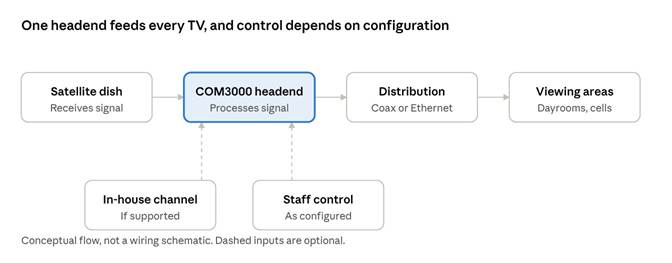
The right approach depends on how many screens you have, what cabling is already in the walls, and how much control staff need. Satellite headends are the common starting point. IPTV is increasingly marketed to correctional buyers, and individual receivers suit small or specialized sites.
| Approach | How it works | Best fit | Watch for |
| Satellite headend | Central equipment receives satellite channels and sends a selected lineup over coax or compatible Ethernet | Many TVs, existing coax, and a fixed approved lineup | A central fault can affect many TVs; housing-unit control may need extra equipment. |
| IPTV / managed digital | Content is delivered over the facility. network and managed in software | Sites that want per-area lineups, scheduling, or lockdown overrides | Network security design; no open internet on endpoints; vendor lock-in |
| Individual receivers | A receiver is installed at each viewing location. | Small sites or a few remote dayrooms | More boxes to configure and maintain; faults stay local |
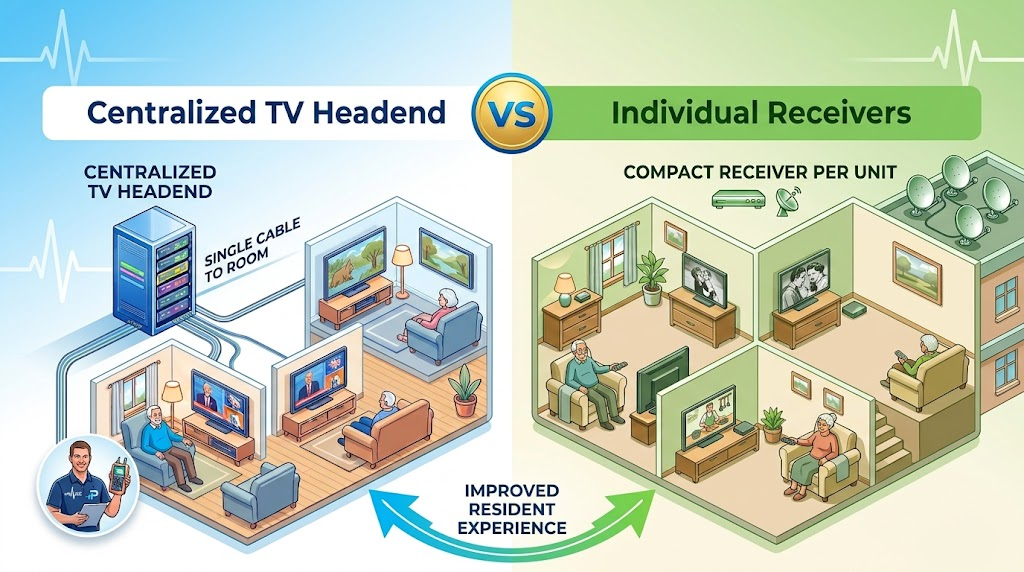
Vendors disagree on how far to push digital. A Correctional News piece sponsored by a smart-headend vendor argues the market is moving from coax to digital, networked systems, and an IPTV vendor lists lockdown override and content filtering as core features. Treat both as vendor positions and ask for references. For a plain-language comparison of the first and third options, read our guide to centralized TV headend vs.individual receivers. It was written for senior living, so apply its technical points but not its examples.
How A Correctional Tv System Differs From A Hotel Or Hospital
A hotel or hospital lets the viewer choose from the property’s channels. A correctional system usually has staff decide the approved lineup, limit what can be changed, and sometimes set different rules by housing unit. A system built for guest rooms does not automatically do this, so ask the installer to confirm each control in writing.
Channel Selection and Staff Control. Ask who selects and changes the lineup, whether unauthorized channel changes can be blocked, whether different housing units can receive different programming, and what equipment or software staff need. Police1’s Marion County report describes a system where corrections staff manage the available programming.
Housing-Unit Control. A headend distributes programming but does not by itself schedule viewing, cut power to a unit, or restrict access. Those functions can require separate controls or integration. Write down the controls you need before you buy.
Dayroom Versus In-Cell TV. Dayroom screens serve shared areas, so plan screen count, viewing distance, approved mounting, and how the signal reaches each room. In-cell TVs add questions about cabling, equipment protection, maintenance access, and replacement cost. Do not treat the two as interchangeable.
In-House Channels. Some facilities want a channel for announcements, training, or approved educational video. That needs a content source and extra equipment beyond ordinary satellite programming. Our guide to the DIRECTV community channel explains the general concept of locally managed content. Confirm security and compatibility for your site before including it in scope.
How a satellite headend delivers TV
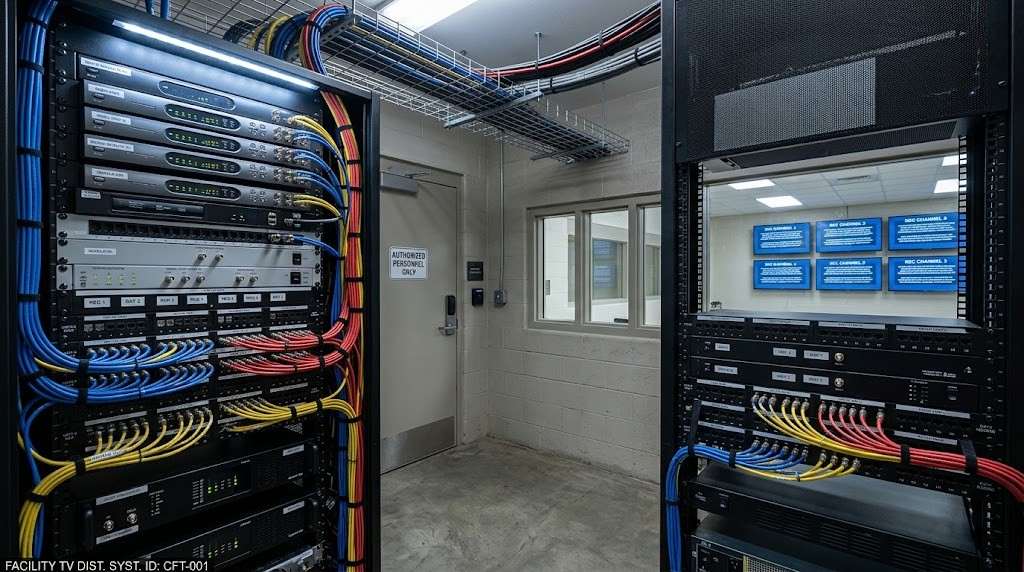
A headend is central equipment that receives satellite programming and sends a selected lineup to many TVs, so you do not need a receiver at every screen. DIRECTV’s COM3000 is a commercial headend of this type, and the right configuration depends on your equipment, distribution wiring, and how many channels you need.
Enclosures, Mounting, And Equipment Protection
Standard commercial mounts rarely meet correctional specifications, so define the hardware before you request prices. Your security and maintenance teams should approve the design before installation starts.
Specialist manufacturers sell protective enclosures and anti-ligature housings for detention settings. The Display Shield describes shatterproof polycarbonate fronts, filtered ventilation, and security screws, and the LCD TV Enclosure describes steel or polycarbonate frames with sloped tops and flush-mount hardware. These are manufacturer claims. Ask any supplier for specifications and references, and do not assume “aligns with ACA standards” means certified.
When you write the hardware scope, cover:
- Which locations need enclosures, and which need anti-ligature designs.
- Approved fasteners, mounting heights, and sealed cable routes.
- Where the headend and any control equipment will be locked away.
- Who owns the replacement when a screen or enclosure is damaged.
- Accessibility needs such as closed captioning, which your counsel or compliance office should confirm for your jurisdiction.
Procurement: What To Put In The Bid And What Drives Cost
A good request for proposal names the screens, the infrastructure, and who is responsible for each, because bed count is not a TV count. A 2025 Louisiana Office of State Procurement addendum for Allen Correctional Center lists 1,608 beds but a television services scope of 94 TVs, with satellite equipment in the administration building and existing lines to individual TVs. The lesson is that a vendor may not be responsible for infrastructure the facility already owns.
Specify these items in the bid:
Equipment and installation scope: dishes, headend parts, receivers, splitters, cabling, mounts, and accessories the vendor supplies.
Existing infrastructure: what is installed, whether it is compatible, and who repairs or replaces it.
Fees: one-time installation separated from recurring programming, equipment, and support charges, plus contract term.
Support: channels, service hours, response expectations, and who diagnoses faults.
Remote access: who may connect to the system and what approvals apply. Our post on remote support for DIRECTV COM3000 systems explains how remote troubleshooting works on commercial headends.
Expansion: how adding TVs, changing the lineup, or adding an in-house channel changes cost.
What drives cost? Price is shaped by the number and location of TVs, headend and distribution equipment, cabling condition, hardware protection, programming package, installation conditions inside the secure site, and ongoing support. We do not publish a single price because these vary widely. Ask each vendor for an itemized quote so bids can be compared. For a related pricing walkthrough from another sector, see how TV service costs are structured for senior living.
If you are replacing an older cable setup, our guide to switching a business from cable to DIRECTV covers transition planning, and our AEP business entertainment guide explains another commercial DIRECTV option. Add correctional requirements on top of both.
What Installation Involves in a Secure Facility
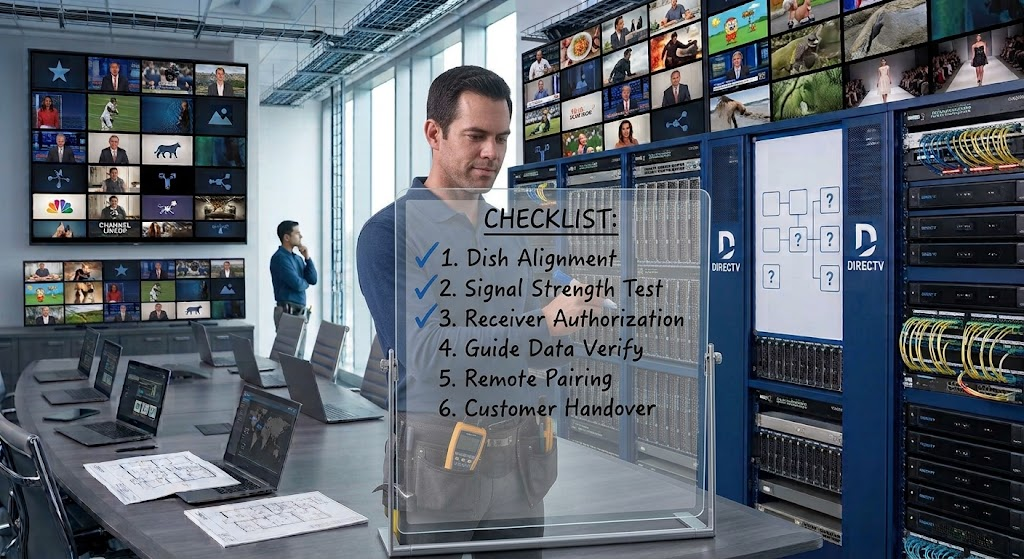
Installation in a secure site starts with facility rules, not with equipment. The steps below are a general planning sequence, and each facility’s security office sets the final requirements.
1. Site Survey. Count TVs and mark locations, pick the headend room, inspect cabling, and find wiring routes. Flag any area needing special authorization.
2. Access and Tool Control. Agree on personnel clearance, escorts, working hours, tool inventory, and equipment inspection before technicians are scheduled.
3. Cabling Evaluation. Test existing coax or Ethernet before including it in the design. Reuse only what passes inspection.
4. Install and Configure. Mount the approved headend, distribution parts, and TVs to the agreed design, and confirm the lineup and any control functions before commissioning.
5. Test and Document. Confirm each TV gets the expected programming with acceptable picture and audio, test every staff control in scope, and receive documentation of equipment, configuration, results, and support terms.
For a general installation sequence, see our commercial DIRECTV installation checklist, then add your site’s security and access requirements. Photos of finished commercial installs are in our install gallery.
Correctional Facility Tv Planning Checklist
Use these questions to write an RFP or compare quotes. Giving every vendor the same scope makes exclusions easy to spot.
| Question | Why it matters |
| How many TVs, and where? | Sets equipment and installation scope |
| Dayrooms, cells, or both? | Changes mounting, cabling, protection, and maintenance |
| Which channels and educational programs are required? | Defines lineup and any specialized content |
| Who controls the lineup? | Identifies required staff-control functions |
| Is separate housing-unit control needed? | Decides if power, access, or scheduling controls are required |
| Satellite headend, IPTV, or receivers? | Drives infrastructure, security design, and recurring cost |
| Can existing cabling be reused? | Affects compatibility, labor, and replacement cost |
| Is an in-house channel required? | Adds content source, equipment, and configuration |
| What mounting and enclosure specs apply? | Keeps the design inside facility-approved requirements |
| What are the contract terms and recurring charges? | Makes proposals comparable |
| What support and remote access are included? | Clarifies service duties and who may connect |
| How will expansion be handled? | Shows the cost of adding TVs or changing programming |
| What testing and documentation are required? | Sets acceptance criteria for the finished job |
Working With Pulsetvnet On A Correctional Tv Project
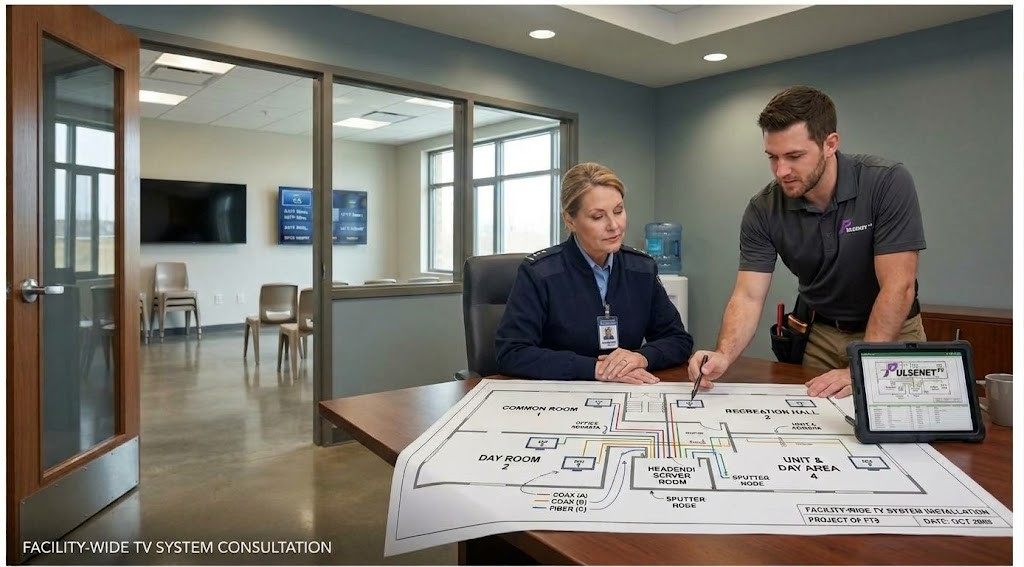
PulseTVNet plans and installs commercial DIRECTV systems, including headend-based distribution, and supports them remotely. Our site lists certified DIRECTV installers and work in healthcare and residential care through our Hospitals & Institution and Senior Living pages, with a nurse call systems line for care settings.
Before you sign with any vendor, including us, confirm in writing which of these are in scope: secure-site clearance and escorts, protective enclosures, housing-unit controls, correctional channel restrictions, an in-house channel, and remote-access approval. Do not assume a general institutional install includes them.
To start, send us your TV count, room types, and existing cabling, and we will outline a scope you can compare against other bids. Request a consultation or call 888-819-5707.
Frequently Asked Questions
Why is TV important in correctional facilities?
It gives access to news and information, structured recreation, and sometimes educational content, and it supports facility behavior policies. Results depend on the rules and how viewing is managed.
What is the difference between a satellite headend and IPTV?
A headend receives satellite channels centrally and sends a selected lineup over coax or compatible Ethernet. IPTV delivers managed content over the facility network and can offer finer control, but it needs a secure network design with no open internet on endpoints.
How much does a correctional TV system cost?
Cost depends on TV count and location, headend or IPTV equipment, cabling condition, protective hardware, programming, secure-site installation conditions, and support. Request an itemized quote that separates installation, equipment, recurring fees, and optional services.
Can existing cabling be reused?
Yes, if it is compatible and passes inspection and testing. A site survey should identify what needs replacement before the price is final.
Can we add an in-house channel?
Often, if the system and added equipment support it. Confirm the content source, hardware, configuration, and approval process before putting it in scope. See our community channel page.
Do we need protective enclosures for every TV?
Not always. It depends on the location, risk level, and facility policy. Have your security team set the specification before you request pricing.
How can we upgrade an older cable TV system?
Document the existing equipment, cabling, programming, contract, and TV count. Then compare upgrading in place with moving to another distribution platform. Our guide to switching a business from cable to DIRECTV covers general transition planning.